The Society for the Study of American Women Writers is excited to present our upcoming virtual event, “Crosscurrents: Indigenous Women’s Archives” on Friday, November 13th, from 12PM – 1 PM CDT / 1PM – 2PM EST.
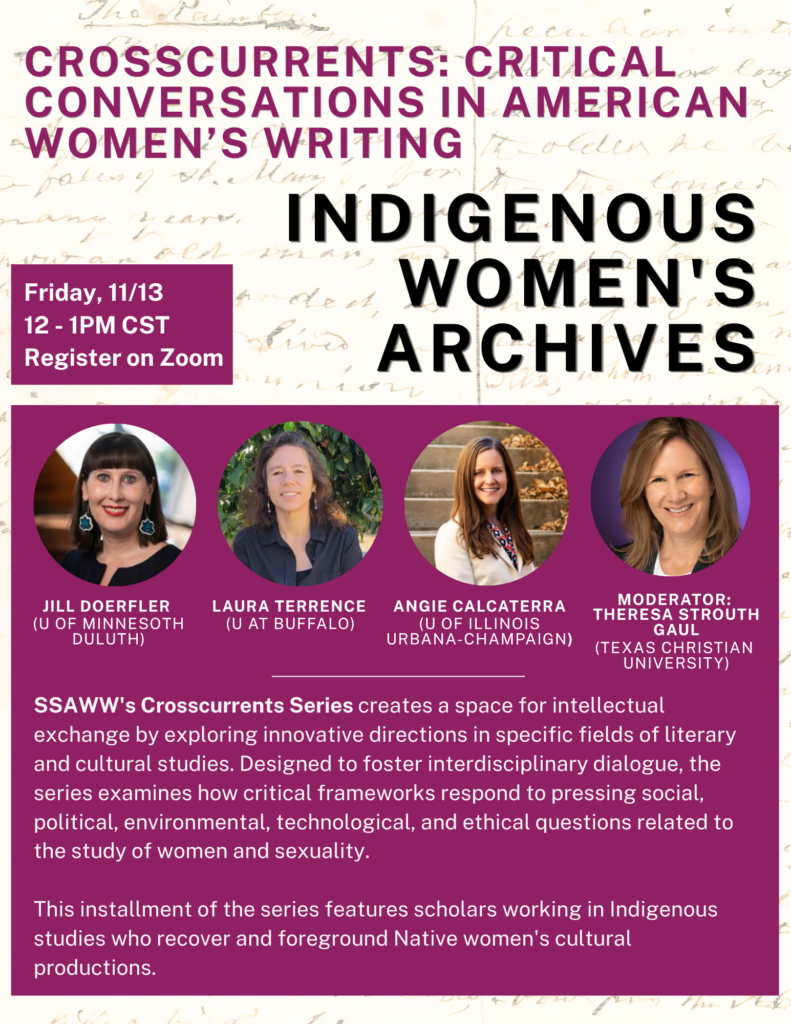
SSAWW’s Crosscurrents Series creates a space for intellectual exchange by exploring innovative directions in specific fields of literary and cultural studies. Designed to foster interdisciplinary dialogue, the series examines how critical frameworks respond to pressing social, political, environmental, technological, and ethical questions related to the study of women and sexuality. This installment of the series features scholars working in Indigenous studies who recover and foreground Native women’s cultural productions.
After registering here, you will receive a confirmation email containing information about joining the meeting: https://us06web.zoom.us/meeting/register/guJoTTCRRD6OCG1Wam3qPA
November’s panel includes Jill Doerfler (University of Minnesota Duluth), Angela Calcaterra (University of Illinois Urbana-Champaign), and Laura Terrance (University at Buffalo), who will discuss their work on Indigenous women’s archives. The conversation will be moderated by SSAWW President, Theresa Strouth Gaul (Texas Christian University).
The Ojibwe Muzzeniegun Digital Edition Collective is a team of interdisciplinary scholars, including Angie Calcaterra and Jill Doerfler, who are working to create a digital edition of the Ojibwe Muzzeniegun, a manuscript magazine that Jane Johnston Schoolcraft and her family members collectively created in 1826-27. Their goal is to make this significant work of early Indigenous literature publicly accessible. Working with Tribal partners and an advisory board, they are developing digital tools that innovatively illuminate the contexts of translation, exchange, and appropriation crucial to the magazine’s production yet obfuscated in contemporary scholarship. With a 2023-25 planning grant, they developed editorial and workflow policies, built relationships with community partners, and digitized and transcribed all magazine issues. A recent ACLS grant is providing an opportunity to build on this success. They are working to create a digital platform and develop resources for reading and teaching the Muzzeniegun with collaborators.
Laura Terrance’s forthcoming manuscript, Generative Violence: Revenge and the Unsavage Body considers the relationship between violence, the body, and subjectivity. Within a savage/civilized binary settler structures uphold efforts to eliminate Indigenous people and exploit racialized “others” through various forms of settler state violence. Exploring expressions of violence or threats of violence, however, as retributive acts can elicit anti-colonial thought and action. Violence, in these contexts, acts as a productive force that refuses colonial ideologies and the continuation of colonized subjectivities. This effect is punctuated when women become the aggressors, defying typical narratives of passive victims. Approaching the subject through film and other media depicting violent women, the book explores how refusing the binary savage/civilized by enacting violence generates a new subjectivity absent moral superiority or empowerment but capable of imagining a future rooted in social justice that exceeds the confines of the settler state.
Bios of presenters:
Jill Doerfler (Anishinaabe, White Earth Nation) is a Professor and the Department Head of the Department of American Indian Studies at the University of Minnesota Duluth. Her primary area of scholarly interest is American Indian, specifically Anishinaabe, identity with a political focus on citizenship. From 2016 to 2020, she co-coordinated and participated in a Minnesota Chippewa Tribe wide grassroots community education and empowerment project designed to empower people to be full participants in their tribal governments. Her publications include Those Who Belong: Identity, Family, Blood, and Citizenship Among the White Earth Anishinaabeg (Michigan State University Press, 2015), Deb Haaland: First Native American Cabinet Secretary (Lerner Publications, 2023), Indigenous Media Ecologies (University of Nebraska Press, 2026) and more.
Angela Calcaterra is an Associate Professor in the American Indian Studies Program at the University of Illinois Urbana-Champaign who specializes in Indigenous North American Literatures, the history of US settler colonialism, and early American studies. Her first book, Literary Indians: Aesthetics and Encounter in American Literature to 1920 (University of North Carolina Press, 2018), seeks to reorient American literary history to accommodate Indigenous temporalities, forms of creative representation, and geographies. She is currently working on her second book project, titled Bearing Arms: US Gun Violence and Indigenous Relationality. The book is a literary and cultural archaeology of American gun violence focused on settler colonialism and Indigenous perspectives on weapons technologies.
Laura Terrance (Akwesasne Mohawk, Wolf Clan) is an Assistant Professor in the Department of Indigenous Studies at the University at Buffalo. Her research focuses on questions of anti-colonial violence, specifically revenge, in a context of ongoing settler colonial violence. Using various forms of media and cultural production, it employs Indigenous feminist and Black feminist frameworks to understand how representations of violence are a productive force that refuses colonial ideologies and the continuation of colonized subjectivities.
Theresa Strouth Gaul is director of the Core Curriculum and professor of English at Texas Christian University. Her research focuses on US women’s writing, early Indigenous writers, letters as a literary form and early multicultural writings in Texas. Cherokee Sister: The Collected Writings of Catharine Brown, 1818-1823 (2014), which received the Society for the Study of American Women Writers Triennial Scholarly Edition Award in 2015, and To Marry an Indian: The Marriage of Harriett Gold and Elias Boudinot in Letters, 1825-1839 (2005) showcased her use of feminist methodologies for recovering archival manuscripts. Her essays have appeared in American Literature, J19, Legacy, Women’s Studies and other journals, and her most recent co-edited book is Being in Relation: Indigenous Peoples, the Land, and Texas Christian University, 1873-2023 (2025).